



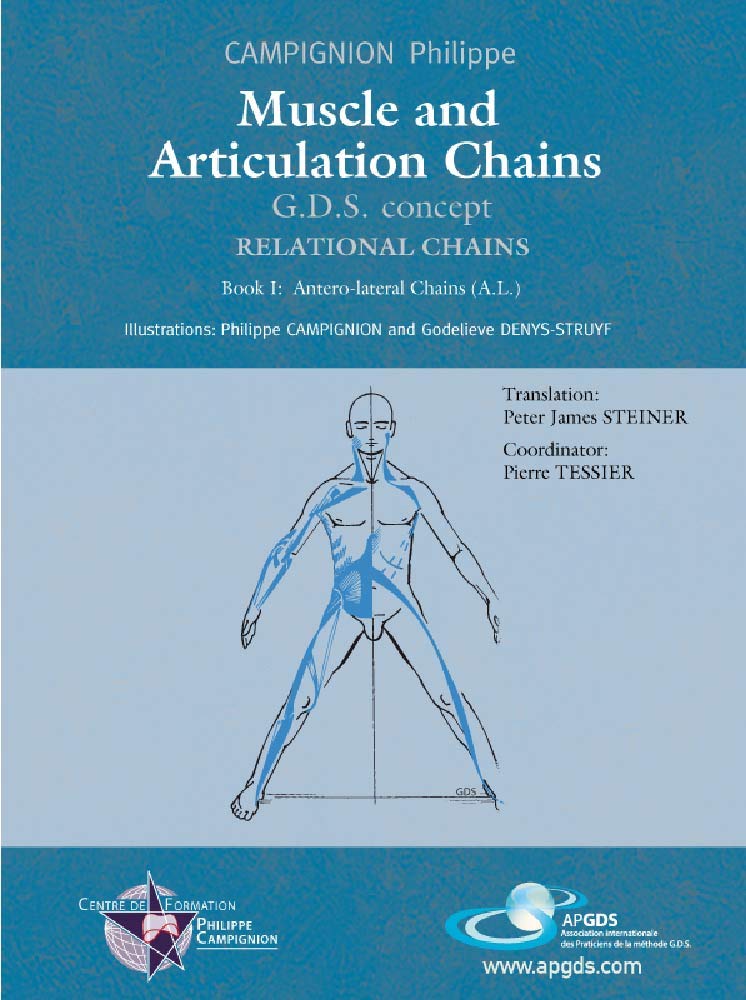
Muscle and Articulation Chains - G.D.S. Concept - Relational Chains - Book 1: Antero-lateral Chains (AL)

 4.7 (140 items)
 Limited Time Sale
$27.41 cheaper than the new price!!
Free cash-on-delivery fees for purchases over $99
Product details
| Management number | 233388034 | Release Date | 2026/06/27 | List Price | $18.28 | Model Number | 233388034 | ||
|---|---|---|---|---|---|---|---|---|---|
| Category | |||||||||
The GDS Method of Muscle-Joint Chains Starting in the 1960’s and 1970’s, Godelieve Denys-Struyf worked on a multifaceted approach – physiotherapy, behaviour, health care, preventative medicine, self-management – to treat patients on an individual level according to the notion of “predisposing terrain”. This is the second manual in a series covering the GDS Method of Muscle-Joint Chains. It follows the introductory manual on Basic Notions that lays down the underlying principles that provide the groundwork to better tackle the in-depth study of each chain found in subsequent manuals. This edition uses diagrams and photographs to help target the anatomical psycho-pathological nature of myofascial tension in the anterolateral chain, which comes from a withdrawn relationship to the surrounding world. When in excess, this withdrawn nature can lead to introversion whereby the body folds in on itself as a defence mechanism. G. Denys-Struyf uses the term “articulation series” to refer to the set of specific muscular imprints and joint disorders that arise from each chain progressively contracting. Tension in the abdominal wall hinders respiratory and digestive functions, thereby substantiating the notion of a lung-large intestine energy hub. Such parallels can be found in the philosophy of Chinese medicine. Links to the element “metal” and its associated energy colours – ranging from blue to off-white – inspired the blue colour chosen for both the cover and the illustrations that appear in the manual. A dominant chain gives rise to antagonistic reactions. The case here is that anterior chains show signs of excess by leaving specific imprints on the body that are often painless but linked to directly related visceral disorders (eg. spastic constipation, sphincter spasms, etc.). Posterolateral chains – direct antagonists of anterolateral chains – react to being overpowered by triggering various muscle spasms throughout the body (eg. piriformis syndrome, scapulohumeral periarthritis, cervicobrachial neuralgia, etc.). Observing and correctly interpreting the AL series helps avoid many pitfalls raised by the action-reaction relationship of antagonistic chains, by enabling the practitioner to avoid manipulating reactionary PL structures. These manuals have been devised to help students in our programmes, but will also help beginners learn about the biomechanics behind the method. The work presented in this manual is governed by overarching principles of biomechanical thoroughness, relations to behaviour, and possible links to oriental philosophy as a means to greater holistic understanding. Read more
| ASIN | B07JQCCV2K |
|---|---|
| XRay | Not Enabled |
| Language | English |
| File size | 27.6 MB |
| Page Flip | Enabled |
| Publisher | Editions Philippe Campignion |
| Word Wise | Not Enabled |
| Print length | 205 pages |
| Accessibility | Learn more |
| Screen Reader | Supported |
| Publication date | October 25, 2018 |
| Enhanced typesetting | Enabled |
Bestseller ranking
Anatomy





Customers who viewed this product also viewed
Games


Correction of product information
If you notice any omissions or errors in the product information on this page, please use the correction request form below.
Correction Request Form